Simplifying payments at global scale
AWS payments had evolved across regions, currencies, and teams, creating a fragmented experience for customers. I helped define and design a unified payment experience that could scale across global markets.
Product
AWS commerce platform
Year
Dec 2020 - Jan 2021
Role
UX designer
Platform
Web app

Deliverables
Product strategy
UX research
System design
Global payments
Summary
AWS payments had been built by many teams over time, each owning a piece but no one owning the whole. The result was a fragmented experience that made sense in parts but fell apart end to end.
I partnered across regional, signup, and currency teams to define the problem space from scratch. What began as a design system migration grew into a broader product direction, bringing fragmented payment experiences into one coherent system.
Global scope
Background
A single payment experience had to support customers across different regions, currencies, payment methods, and processors without creating a different product for every market.
Understanding the fragmentation
I started with a baseline study across 15 customers to understand how they managed payments across AWS. The issue wasn't a lack of functionality. Customers struggled to discover what already existed and understand how payment methods, currencies, and account settings connected.

Designing around the customer journey
Different teams owned signup, payment methods, currencies, and regional experiences, each optimizing for its own part of the system.
Rather than redesigning these experiences independently, I used the customer journey as a shared framework to connect them. This helped us move from individual features toward a more unified product model centered on a simple question:

Design
User flow
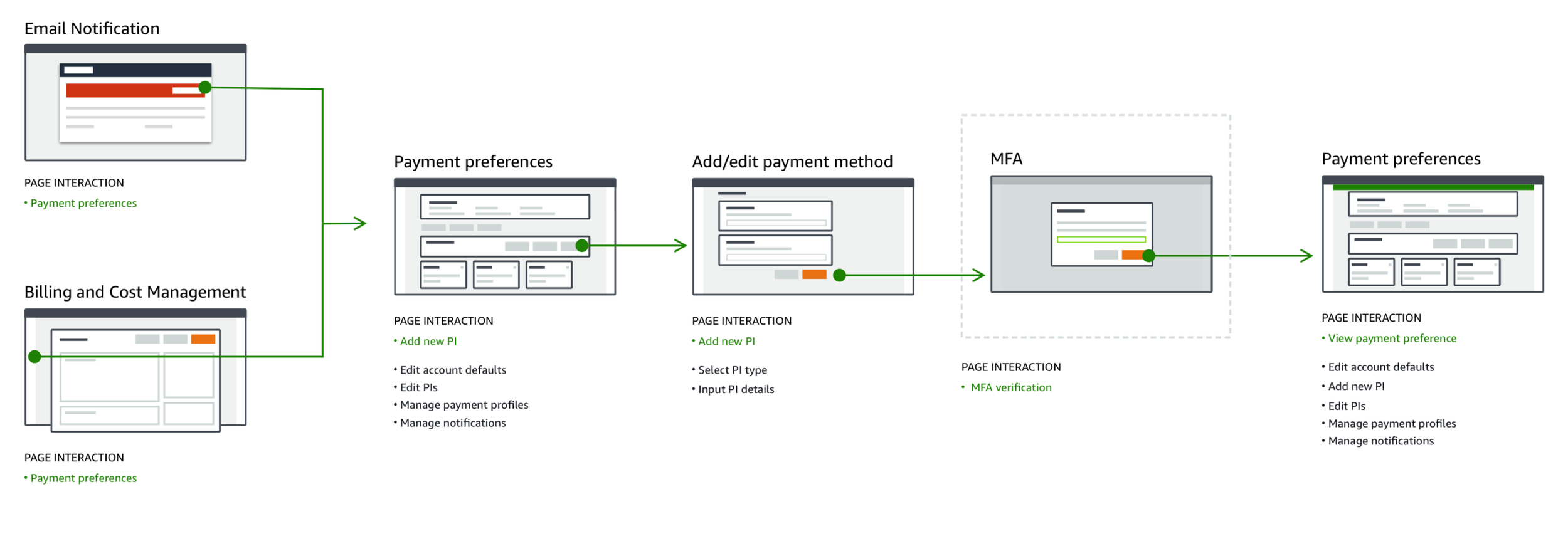
Wireframe
We explored multiple wireframe directions with a focus on three principles:
consolidate payment management into one dashboard
separate the payment method addition flow into a distinct journey
design for regional variation without fragmenting the experience
I worked with regional PMs to document all supported payment types, ensuring every component could flex across markets without losing consistency.

Design exploration: consolidated edits
Design exploration: payment dashboardVariation
Collaborated with regional Product Managers to document all supported payment types (instrument resources), ensuring the component's design could accommodate various regional requirements and payment processor specifications.

Design exploration: account level default based on Payment type What shipped
Payment profile
Customers often use different payment instruments for different AWS services, regions, or business needs, but those relationships were difficult to understand and manage.
Payment Profiles created a clearer way to associate payment preferences with different scenarios while giving customers greater visibility into how AWS would charge them.
The new experience made these relationships easier to discover and manage without requiring customers to understand the underlying payment infrastructure.

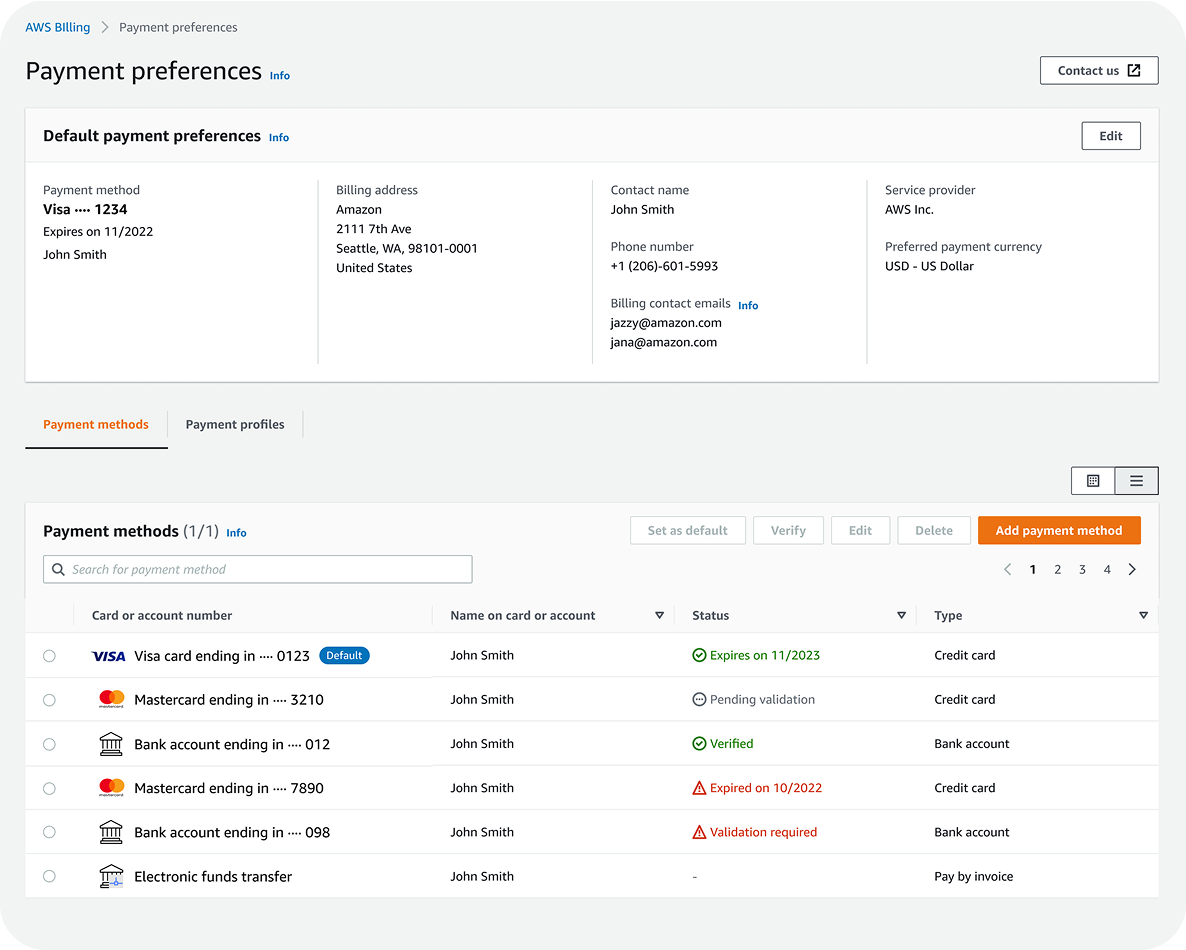
Payment methods redesign
Payment information had historically been distributed across multiple experiences, making even simple questions difficult to answer: What payment method am I using? Where is it used? What can I change?
I consolidated payment management into a clearer destination where customers could understand their available payment methods, preferences, and related account information in context.
Instead of exposing the organizational structure behind AWS payments, the experience was organized around the decisions customers actually needed to make.
New payment currency support
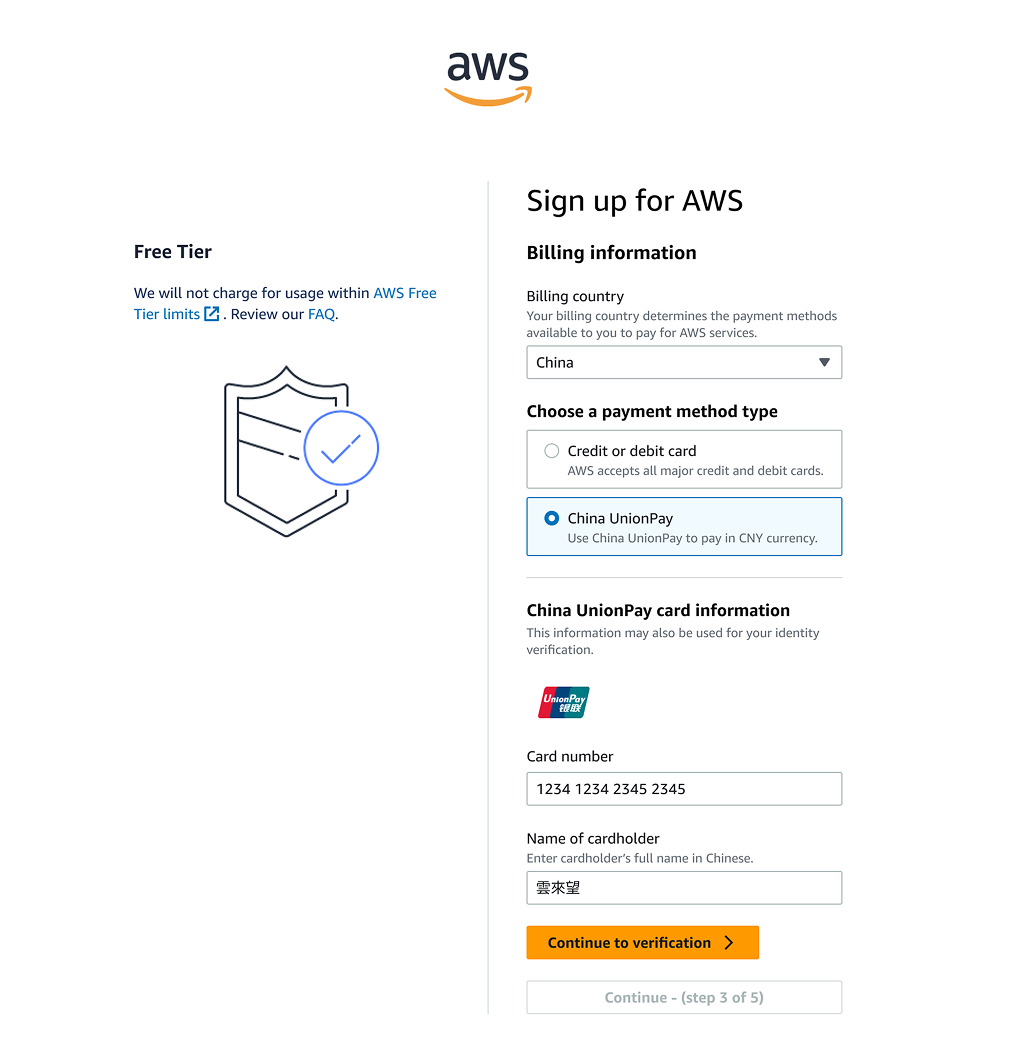
Global payments also meant solving problems that couldn't be addressed through UI consistency alone.
For customers in China, paying AWS bills in a foreign currency introduced additional cost and complexity. I worked across regional and payments teams to design support for CNY as a default payment currency, allowing eligible customers to manage their currency preference directly within the payment experience.
The work extended the same global framework to a distinctly local customer need without creating a disconnected experience.
Impact
Success metric
Launched to millions of AWS customers across global markets.
43% increase in payment profile feature adoption
5k customers updated their default payment currency within months of launch
(a preference that previously didn't exist)Page visits increased from 23k to 33k between October 2022 and January 2023
Customer feedback
“This newly designed page is much easier to use than before”
“The new view consolidates all the information I need in one place and allows me to spoof and troubleshoot any payment issues. It makes it clear if currency, seller of record, or payment method are on track for the customer’s needs.”
“With the new Payment Preferences page offering a more intuitive experience for customers to manage their additional billing contacts, Accounts Receivable will have more up-to-date customer contacts in the long run, improving the ability to communicate with customers and foster more effective collections conversations.”
Takeaway
The most valuable thing I did on this project wasn't designing screens, it was defining what the product needed to become.
By leading research to surface the real pain points, and working across regional, signup, and currency teams to build alignment, I learned that at this scale, the designer's job is as much about shaping direction as it is about craft.